How to grow your Depop in 2026
Depop has changed enough over the last two years that a lot of the advice circulating in seller communities is quietly out of date. Refreshing, free shipping, boosting: all three were standard advice, and all three are now either useless or actively costing you money.
Here's a practical view of what growth actually looks like on the platform in 2026.
- List a few items daily instead of one big weekly drop
- Relist stale items rather than refreshing them
- Keep shipping out of your listed price, buyers only see it at checkout
- Front load descriptions with real descriptors, never keyword stuff
- Skip paid boosts and fix your photos instead
- Work out your true margin after fees before you source again
Consistency beats volume
The algorithm rewards shops that are active, not shops that are big. Listing four or five items a day, every day, will outperform dumping forty items on a Saturday and going quiet for a week. Steady activity keeps you surfacing in search. Bursts do not.
If you can only list once or twice a week, schedule it. Treat it as a fixed slot rather than something you do when you feel like it.
Old listings are dead weight until you relist them
Refreshing used to be the standard advice. It has been deprioritised. What still works is deleting and relisting genuinely stale items, because new listings get a visibility bump that refreshes no longer provide. A reasonable rule: if it's been up for two months with no sale, it goes back up as a new listing.
If an item has been relisted twice and still hasn't moved, the problem is the price, the photos, or the item itself. Relisting a third time won't fix any of those.
Your first line of the description is your search ranking
Depop weights the beginning of your description heavily. Put your real descriptors there: style, era, cut, colour, size. Save the personal context for the bottom.
Do not stuff keywords. Tagging brands you aren't selling, or listing garment types that aren't in the photo, actively hurts your search placement and can get listings removed. The platform has said this repeatedly and it is enforced.
Fewer accurate tags will always outperform twenty irrelevant ones.
Grunge y2k flare low rise pants
Size 6 grey pants with buckle details and wide leg fit. No flaws, from the early 2000s. I love these, they're perfect everyday statement pants, they just don't fit me.
#cybery2k #mallgoth #mcbling #emo #scenecore
Super cool and unique pants!
Just clearing out my closet, love these pants they have lots of cool stuff going on. They're a size 6 and they fit pretty wide leg.
#grey #pants #cool #closetclearout #unique #trippnyc #royalbones #sinister #lipservice #emilythestrange #skirt #lolita #hottopic
The first leads with style, era and cut, so it matches how people actually search. The second tells a buyer almost nothing, tags four brands that aren't in the listing, and includes a garment type that isn't even the item.
Photos do more work than anything else
Plain background, item centred, nothing else in frame. Natural light if you have it, a cheap ring light if you don't. Buyers are scrolling fast and the only question your first photo has to answer is what the item actually is.

Styled flat lays with props look nice on your own grid and convert worse in search. The item should be the only thing competing for attention.
Price the visible number, not the total
Shipping cost is hidden until an item reaches the cart. That means a $25 listing with $7 shipping looks cheaper in search than a $32 listing with free shipping, even though the buyer pays the same. Building shipping into your price makes you look more expensive at the exact moment buyers are comparing.
Free shipping on bundles is a similar trap. Buyers will pair your cheapest item with your heaviest one and you cover the difference. It only makes sense if your whole shop sits at $15 or above.
Skip boosting, fix your fundamentals
Paid boosts eat into margins and rarely produce a lift that justifies the cost. If your items aren't selling, boosting a bad listing just means paying to show more people a bad listing. Fix the photo and the price first.
Cut your shipping costs properly
Third party services like Pirate Ship beat platform labels once you're doing consistent volume. Combine that with polymailers instead of boxes and you're saving a couple of dollars per order, which compounds fast across a few hundred orders a year. A cheap thermal label printer pays for itself inside a month or two of steady sales.
Know your actual margin
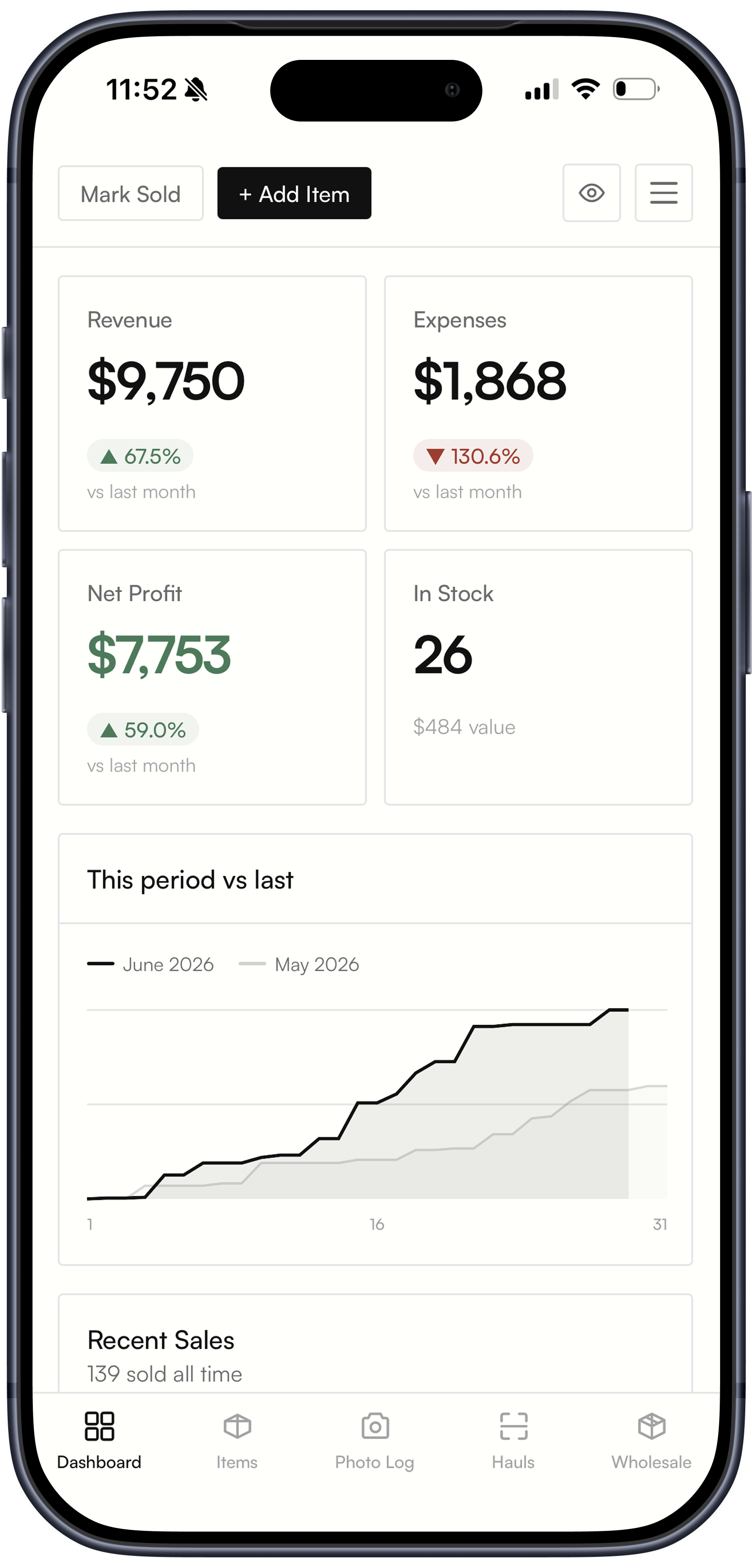
This is where most shops that feel busy but never seem profitable go wrong. Once you subtract platform fees, shipping, packaging and what you paid, a meaningful share of sales come out thin enough that they weren't worth the handling time. You can't fix that until you can see it.
Work a single sale through end to end:
- Listed at $40. That's the number you remember.
- Minus platform fees. Roughly $4 once the payment cut lands.
- Minus the label. Call it $6 for a polymailer going a few states over.
- Minus packaging. Small, but real, maybe $1.
- Minus what you paid. $12 at the bins on a good day.
That's $17 left, not the $28 you had in your head. Do that across a month and you find out which half of your shop is carrying the other half.
Track cost, sale price, platform and date at minimum. That's enough to tell you which categories actually earn, which sourcing trips were worth the gas, and what your real hourly rate looks like. It also makes tax season a non event. Our piece on why resellers who track their numbers make more money goes deeper on the habit itself.
Move what you have before buying more

Unlisted inventory is the most expensive thing in a reselling business. It cost money and it earns nothing. Before your next sourcing run, clear the backlog, reshoot the weakest listings, and bundle the items that have been sitting longest.
Sellers routinely grow their shop over a month or two doing nothing else. No new stock at all, just working through what's already in the bins.
Growth on Depop in 2026 is less about finding a trick and more about removing the leaks. List consistently, describe honestly, photograph plainly, and know your numbers.