How to date vintage Nike tags
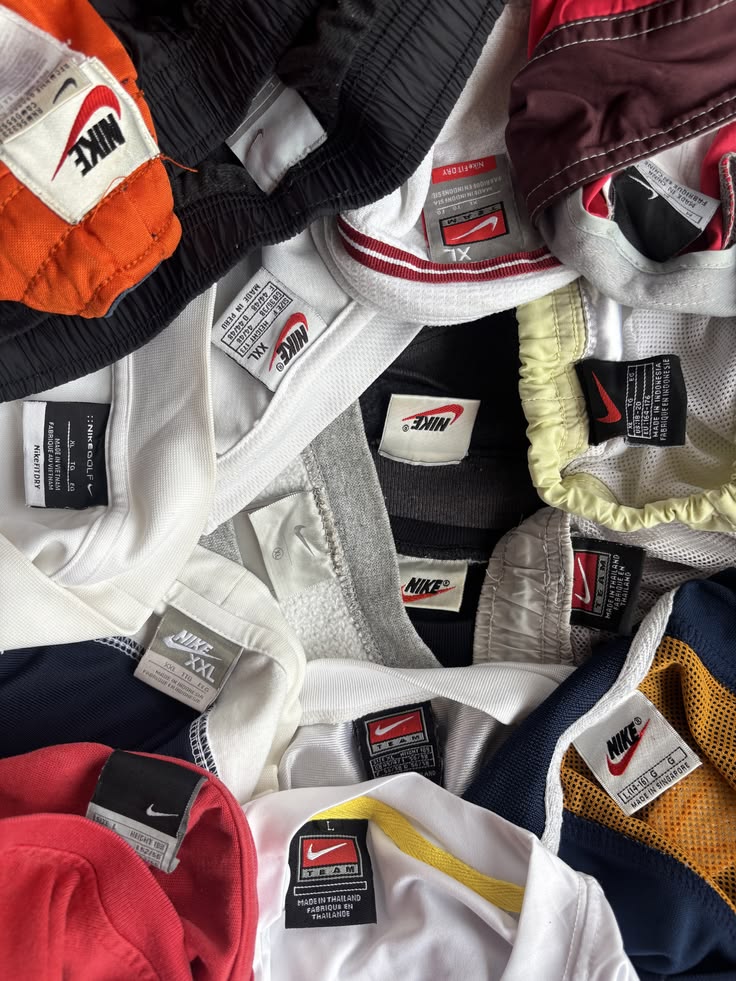
Nike is the most-thrifted brand in vintage, and the most misdated. Walk into any thrift store and you'll find forty Nike pieces spanning thirty years, all hanging together, all priced the same. The neck tag is what separates a $12 flip from a $200 one.
Before we get into the timeline, one thing you should know that most guides won't tell you: Nike has never released an official tag history. Every colour-coded timeline you've seen, including the one below, is community reconstruction built from event-dated shirts and dated catalogue pieces. It's reliable enough to source with, but it dates a period, not a year, and you should never treat it as proof on its own.
So let's start with the part that isn't guesswork.
The one Nike dating method that's actually exact
Tucked underneath the wash tag on most Nike garments is a small label with a six to twelve character serial code. The first four characters encode the season and year the piece was produced.
The season prefixes are:
- SP or S = Spring (January to March)
- SU or U = Summer (April to June)
- FA or F = Fall (July to September)
- HO or H = Holiday (October to December)
The digits after the prefix are the year. So SP20 is Spring 2020. On many codes the next four digits narrow it further to an exact production date, where 0408 reads as April 8th.
The catch: this system is only consistently useful from roughly the late 2000s onward. On genuinely vintage pieces the label is often missing, illegible, or was cut out by the original owner. But when it's there, stop guessing and just read it.
The RN 56323 myth
You will see RN 56323 and CA 05553 on Nike wash tags constantly, and you will see people online treat them as dating clues. They are not.
These are registration numbers assigned to Nike under US and Canadian textile labelling law. They identify the company responsible for the garment and nothing else. Nike has carried the same numbers across decades of production, so an RN number tells you the piece is Nike and stops there. Useful for spotting a fake that got the number wrong, useless for dating.
The neck tag timeline
One hard anchor before the colours: the swoosh did not become a fixture on Nike neck tags until 1987. Earlier tags often ran the Nike wordmark alone. If you're holding a tag with no swoosh on it, that's a meaningful early signal.
Pinwheel label (roughly 1978 to 1982)

Several swooshes arranged in a rotating circular pattern, hence the name. This is the tag most likely to make your week. Genuine pinwheel pieces are scarce and priced accordingly. If you find one in a thrift bin, do not put it back to think about it.
Orange label (roughly 1978 to 1983)

The orange tag runs alongside the pinwheel and is the more findable of the two early labels. Orange ground, Nike wordmark in the brand's early typeface. These are overwhelmingly Made in USA, and the combination of orange tag plus single stitch plus a USA callout is about as strong an early-era read as you'll get.
Blue label (roughly 1984 to 1987)

Nike name and swoosh set against a blue ground. This is the tag that covers the beginning of the Jordan era, which is why blue tag pieces with basketball graphics get bid up hard. Bold, vibrant lettering and a larger logo than the earlier tags. Still frequently domestic production.
Grey label (roughly 1987 to 1994)

The workhorse of vintage Nike. A grey rectangle set inside a white rectangle, with the swoosh and Nike wordmark rendered in red or orange depending on the variant. This is the tag on most of the sought-after late-80s and early-90s graphic tees, and it spans the period when Nike's cultural peak and its manufacturing shift were both happening at once. Expect a mix of USA and offshore production across this range.
Multiple grey label variants exist, and the era overlaps at both ends with the blue tag before it and the black and white labels after it. Don't try to pin a grey tag to a single year off the tag alone.
Black label (around 1994)
A short-lived and genuinely rare tag: dark ground with contrasting Nike branding, noticeably cleaner and more modern than the grey label it replaced. Because the window is so narrow, black label pieces are worth flagging when you find them.
White label (roughly 1994 to 1999)

A basic thin white label, sometimes with the wordmark, sometimes swoosh only. You'll find printed, woven, and embroidered versions, all legitimate. This is the most common "vintage" Nike tag in circulation and the one people most often over-date. A white tag piece is late 90s, not early 90s, and pricing it as early 90s is the single most common Nike mistake resellers make. Global manufacturing expanded significantly through this window, so offshore country callouts here are completely normal.
Red and black label (roughly 1997 to 1999)
High-contrast red and black, mostly seen on sweatshirts, fleece, jackets, and hats rather than tees. A solid late-90s marker.
Silver label (early to mid 2000s)
More technical and minimal in feel than anything before it. Once you're into silver tags you're out of vintage and into "y2k," which is its own growing market but priced differently. Worth knowing so you don't pay vintage money for it.
Reading the country callout
Country of manufacture supports the tag, it doesn't override it. Made in USA, Mexico, or Spain skews earlier. Large-scale Asian production skews later. But Nike manufactured authentic apparel across many countries throughout the 80s, 90s, and 2000s simultaneously, so an offshore callout on its own proves nothing about age and definitely nothing about authenticity.
Spotting fakes
The most reliable fake tell on Nike is the stitching on the label itself. Counterfeit neck tags are typically attached with sloppy, uneven, or loose stitching, because that's the step nobody bothers to get right. After that, check the swoosh geometry: the curve should taper smoothly and the tip should be sharp, not blunt or stubby. Then check spelling and font weight. A good fake copies the logo, and almost never copies the stitching, the wash tag format, and the serial label all at once.
Quick cheat sheet
No swoosh on the neck tag means pre-1987. Pinwheel or orange means late 70s to early 80s and you should be excited. Blue is mid 80s. Grey with orange swoosh is late 80s to 1994, the sweet spot. Thin white is mid to late 90s, not early 90s. Silver is 2000s and isn't vintage yet. Any RN number tells you nothing about age. A readable serial code beats every one of these, so check for it first.
When you pull a Nike piece, log the tag era and what you paid at the moment of purchase, while the tag is still in your hand. Six months and two hundred items later, you won't remember whether that hoodie was a grey tag or a white tag, and the difference is most of your margin. Hauly is built to keep exactly that record, and after a few months it'll start telling you which Nike eras are actually worth your sourcing time.